Inflammation Explained: The Hidden Fire Slowing Your Recovery
Strength & Motion Academy Podcast Recap 🎙️
Ever had one of those weeks where your body just feels off?
You are training, trying to eat well, getting on with life, but you still feel sore, flat, tired, or stiff. Your energy is low, your recovery feels slow, and your body just does not seem to bounce back the way it should.
If that sounds familiar, inflammation could be playing a bigger role than you think.
In this week’s podcast, Josh and Nav unpacked a topic that affects far more people than most realise: inflammation. It sounds intense, but once you understand what it is and how it works, a lot of things start to make sense.
And no, this is not one of those “you need to become perfect overnight” conversations.
This is about understanding your body better, training smarter, and making a few simple changes that help you recover well and feel stronger over time. 💪
If you have not watched the full episode yet.
Inflammation Explained: What Is Really Going On? 🔥
Let’s keep it simple.
Inflammation is your body’s natural response to stress, damage, or irritation. It is part of your built-in defence system. When something needs attention, your body sends help.
That help can show up as:
- swelling
- heat
- soreness
- stiffness
- tenderness
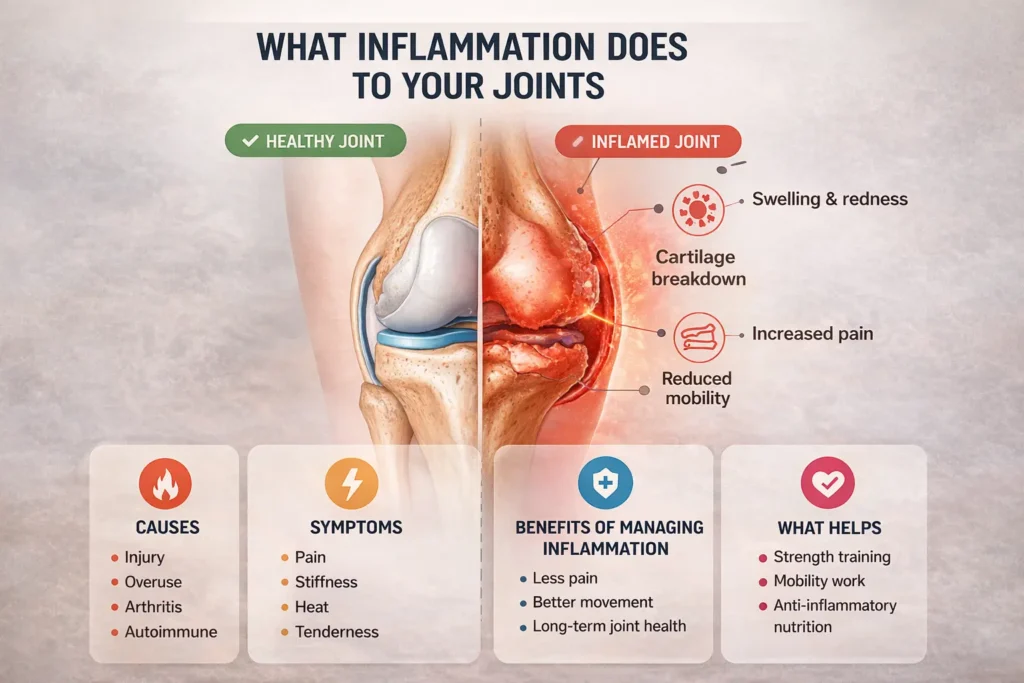
Sometimes, that is exactly what you want.
If you train hard, sprain an ankle, or push your muscles properly in the gym, your body responds with short-term inflammation to protect the area and begin repair. That is a normal and healthy part of the process.
This is called acute inflammation.
The issue is when inflammation hangs around longer than it needs to.
That is where chronic inflammation comes in. It is lower-level, often harder to notice, and can quietly affect your recovery, energy, mood, digestion, sleep, and progress in the gym.
So no, inflammation is not always bad. But too much of it for too long can absolutely slow you down.
The two types of inflammation 🩹
Acute inflammation
This is the helpful kind.
It usually happens when:
- you have trained hard
- your body is repairing muscle
- you have picked up a minor injury
- your body needs to protect and heal something
Think muscle soreness after a solid session or swelling around a rolled ankle. It is short term, it has a job to do, and it helps you recover and adapt.
Chronic inflammation
This is the one that causes problems.
It tends to build up when your body is under too much stress for too long. That stress might come from:
- poor sleep
- poor food choices
- not enough recovery
- too much sitting
- too much life stress
- training hard without enough balance
This kind of inflammation is more like background noise. It does not always hit you all at once. It builds quietly, then suddenly you realise you feel run down all the time.
Signs you might be more inflamed than you realise 🤔
Most people do not walk into the gym and say, “I think I have chronic inflammation.”
They usually say things like:
- “I’m always tired”
- “I feel sore all the time”
- “I’m training, but not recovering”
- “My body just feels heavy”
- “I’m doing the work, but I don’t feel good”
At Strength & Motion Academy, this is something we see more often than people think.
Some common signs include:
🥱 persistent fatigue
⚡ soreness that lingers too long
🤢 digestive discomfort or bloating
🧠 brain fog
😤 low mood or irritability
💤 feeling stiff, flat, or slow to recover
That does not automatically mean inflammation is the only cause, but it is often part of the bigger picture.
Your body is always giving you feedback. The trick is learning how to spot the patterns before they become bigger problems.
Why this matters for training 🏋️♂️
This is where it becomes important.
If your body is constantly under stress, it becomes much harder to:
- recover properly
- perform well
- build strength
- stay motivated
- keep showing up consistently
That is why so many people get stuck in a frustrating cycle.
They train hard for a week or two, feel wrecked, miss sessions, lose momentum, then try to “start fresh” again. It becomes all or nothing, which only adds more stress to the body.
That is also why recovery should never be treated like an afterthought.
You do not make progress just by working hard. You make progress by doing work your body can actually recover from.
If that stop-start pattern sounds familiar, How to Be Consistent is a really useful next read because it ties in perfectly with this. Better recovery often leads to better consistency, and better consistency usually leads to better results.
Why it sneaks up on people 👀
Chronic inflammation is tricky because it rarely feels dramatic at first.
It builds slowly.
You might just feel:
- a bit more tired than usual
- a bit more achy than normal
- a bit less motivated
- a bit less sharp
- a bit more run down
Nothing feels huge on its own. But over time, those little things start stacking up.
Then one day you realise your sleep has been poor, your recovery is poor, your body always feels tight, and your workouts feel harder than they should.
That is why this stuff matters.
It is not always one massive issue. Sometimes it is lots of smaller things quietly pulling you backwards.
Chronic inflammation explained without going overboard 🌿
The good news? You do not need to become extreme.
You do not need a weird diet, a complicated routine, or a cupboard full of supplements. Most people get the best results by doing the basics better and doing them more consistently.
Here are some of the biggest wins:
😴 Prioritise sleep
Sleep is one of the best recovery tools you have. If your sleep is poor, everything else gets harder.
💧 Stay hydrated
A lot of people are simply under-hydrated. Water supports recovery, digestion, energy, and performance more than most people realise.
🏃 Move regularly
Even outside the gym, simple movement helps. Walking, mobility work, and getting out of “sit all day” mode can make a real difference.
🧘 Manage stress better
Training stress and life stress both count. If your work is hectic, your sleep is off, and your head feels fried, your body still has to deal with all of that.
🥗 Eat like you care about recovery
You do not need perfect food. You do need enough protein, better food choices most of the time, and less random rubbish when possible.
💊 Use supplements sensibly
Magnesium, omega-3s, and a quality multivitamin can help, but they work best when the basics are already in place.
Recovery and injury prevention go hand in hand 🚑
When your body is under constant stress, small issues tend to become bigger issues much faster.
That tight shoulder you keep ignoring. That sore knee after leg day. That lower back that always feels a bit “not right”. When recovery is poor, those little warning signs usually hang around for longer.
That is why smart training is not just about pushing harder. It is about knowing when to push, when to ease off, and how to support your body properly in between.
If that sounds familiar, How to Avoid Injury in the Gym is well worth reading next. It fits naturally with this topic because staying healthy enough to train matters just as much as training hard in the first place.
Final word: support the fire, do not fight it 🔥
Inflammation is not the enemy.
The right kind helps your body heal, adapt, and come back stronger.
The problem is when stress, poor recovery, lack of sleep, and poor habits keep that system switched on for too long. That is when progress slows, energy drops, and your body starts feeling like it is working against you instead of with you.
The answer usually is not something extreme.
It is better structure. Better recovery. Better habits. Better coaching.
That is what we focus on at Strength & Motion Academy.
We want people to train hard, recover well, feel better, and build something they can actually stick to for the long term.
If you are based in Midvale and want support from coaches who care about more than just making you sweat, take a look at Strength & Motion Academy and see what we are all about.