How to Stay Consistent with Training: Manage Energy, Not Just Time
Strength & Motion Academy Podcast Recap 🎙️
A lot of people think consistency is just a time problem.
They tell themselves they would train more if they had a better schedule, more motivation, or more discipline. But in reality, that is only part of the picture.
At Strength & Motion Academy, what we see most often is not a lack of time. It is poor energy management.
If you want to know how to stay consistent with training, you need to stop looking only at your diary and start looking at your recovery, sleep, food, stress, and training load.
Because when your body is running on fumes, consistency becomes much harder to maintain.
Why Most People Burn Out
Most people do not fall off because they are lazy.
They fall off because they are:
- overcaffeinated ☕
- underslept 😴
- underfed 🍽️
- training hard but recovering poorly 💥
That creates a cycle where people keep trying to push through fatigue instead of fixing the reason they are tired in the first place.
When that happens, training starts to feel like a grind. Sessions feel heavier than they should. Motivation drops. Recovery slows down. Then people miss a few workouts, lose rhythm, and feel like they are back at square one.
That is why how to stay consistent with training is not really about trying harder. It is about building a body and a routine that can actually handle the work.
If you want a deeper look at what poor recovery can do to the body, our guide on inflammation explained is a useful next read.
Real People. Real Results.
We have seen this play out with real members.
Ziggy dropped 45kg and went from 30% body fat to under 10%, but that only happened once his nutrition and recovery improved.
Glenn, an endurance athlete, gained fat despite training hard because he was skipping breakfast, under-recovering, and living in constant fatigue.
Neither of them needed more workouts.
They needed better systems.
That is one of the biggest lessons when learning how to stay consistent with training. More effort is not always the answer. Sometimes the answer is doing less, but doing it better.
How to Stay Consistent with Training Without Burning Out
If you want better long-term results, a few simple ideas make a huge difference.
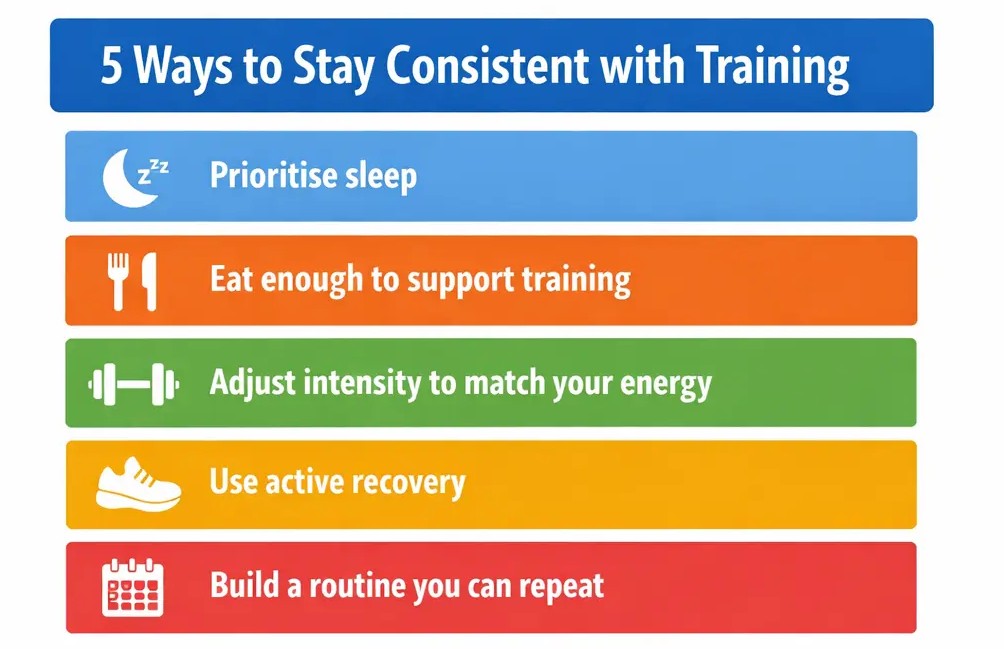
1. Use effort properly
Not every workout needs to be all-out.
A lot of people train like every session is a test. That works for a short time, then catches up with them. Using RPE, or rate of perceived exertion, helps you match the workout to the energy you actually have on that day.
2. Think in systems, not isolated habits
Sleep affects food choices. Food affects energy. Energy affects training quality. Stress affects all of it.
If one part of the system is off, the others usually suffer too.
3. Adjust based on reality
Some weeks your energy is high and you can push. Other weeks you need to pull back, recover, and keep momentum without digging yourself into a hole.
That flexibility is a big part of how to stay consistent with training over months, not just for one good week.
Caffeine, Sleep and the Energy Trap
One of the easiest ways to wreck consistency is relying on caffeine to cover up poor recovery.
Caffeine is not the problem by itself. The problem is when it becomes your solution for being under-recovered.
That usually leads to a loop like this:
- more coffee
- worse food decisions
- poorer sleep
- more burnout
Then people wonder why training feels harder every week.
If you want to break that cycle, you need to protect your sleep, manage your stress, and stop treating tiredness like something to ignore.
If you want an outside reference on why recovery matters so much for performance, this systematic review on sleep and athletic performance is a useful read.
Active Recovery Is Not Optional
A lot of people hear the word recovery and think it means doing nothing.
That is not the point.
Recovery is about knowing when to push and when to pull back. It is what keeps your training sustainable.
That can include:
- mobility and matwork
- accessory training
- outdoor walks
- sauna
- better sleep habits
Active recovery is not about being soft. It is about making sure your body is ready to train again.
If you are serious about how to stay consistent with training, recovery cannot be treated like an optional extra.
The Recovery Hierarchy When You’re Time-Poor
When life gets busy, keep it simple.
If you do not have time for everything, focus on the things that move the needle most:
- quality sleep
- intentional rest
- active recovery
- stress reduction
That is where people often overcomplicate things.
They look for fancy routines, supplements, or perfect programmes, when the basics are what actually keep them going.
Build Routines That Work for You
The best plan is not the one that looks most impressive on paper.
It is the one you can repeat.
A few habits that help a lot:
- track your energy highs and lows
- adjust training based on how you feel
- match nutrition and hydration to training demand
- build a recovery system that fits your real life
That is the real answer to how to stay consistent with training.
Not more guilt.
Not more pressure.
Not pretending every week feels the same.
Just better awareness, better systems, and better decisions.
Final Word
Consistency is not discipline.
It is alignment.
When your training matches your energy, your recovery supports your workload, and your routine fits your life, showing up becomes much easier.
That is why how to stay consistent with training is really about understanding your body, respecting your limits, and building a system that helps you keep going.
And if you are in Midvale and want support from coaches who can help you train smarter, recover better, and actually stay on track, Strength & Motion Academy is a great place to start.
If you want another helpful read after this one, our beginner guide on how to avoid injury at the gym fits naturally with this topic too.