How To Avoid Injury at the gym as a Beginner?
If you want to avoid injury at the gym, the key is starting at the right level, learning good form, and building gradually. Starting the gym for the first time can feel intimidating.
For most beginners, the biggest fear is not looking silly or being unfit. It is getting injured, making an old issue worse, or being pushed too hard before the body is ready.
That fear is completely normal, especially if you already feel stiff, out of shape, or unsure what your body can handle.
You might be thinking:
- What if training makes this worse?
- My shoulder already feels tight
- My hips have no mobility
- I do not want to be thrown into hard workouts too soon
Those concerns are valid.
The good news is that beginner gym training should not feel like punishment. It should not be about being smashed into the ground, copying advanced workouts, or forcing your body into positions it cannot control.
If you want to avoid injury as a beginner at the gym, the answer is simple: start from your real fitness level, learn proper form before adding weight, choose exercises that suit your body, and build gradually over time. 💪
That is what helps beginners train safely.
That is what builds confidence.
And that is what makes progress sustainable.
Start With Your Real Starting Point
One of the biggest mistakes beginners make is following a programme that has nothing to do with their current body, fitness level, movement quality, or injury history.
Before you think about lifting heavier or training harder, you need to understand where you are actually starting from.
That includes things like:
- how long it has been since you trained properly
- whether you have any old injuries or problem areas
- what movements feel tight, awkward, or unstable
- how confident you feel in a gym environment
- what your real goals are
This matters because two people can both be beginners and still need completely different approaches.
A 25-year-old who used to play sport is not the same as someone in their 50s or 60s who has not trained in years and struggles with shoulder stiffness, poor mobility, or low confidence.
A safe beginner programme should always start with the body you have now, not the body you used to have or the body you wish you had.
Learn Proper Form Before You Add More Weight
If you want to avoid injury at the gym, this is one of the most important things to remember:
Master the movement before you make the movement harder.
A lot of beginners assume results come from intensity alone. They think more weight, more reps, and more effort automatically mean more progress.
They do not.
One of the fastest ways to get hurt is adding load before your body has learned how to control the exercise properly.
As a beginner, your first job is not to lift heavy. Your first job is to learn how to move well.
That means:
- understanding how the exercise should feel
- using a range of motion your body can actually control
- choosing a manageable weight
- building good movement patterns before chasing intensity
If you already have limitations in areas like your shoulders, hips, knees, or lower back, this matters even more.
You do not force your body into positions it cannot control. You improve control first, then build from there.
Use Exercises That Match Your Current Ability
A good beginner gym programme should not be built around random exercises that look impressive on social media.
It should be built around movement patterns that make sense for your body right now.
That is a huge part of injury prevention ✅
For example:
- if your hips are tight, some squat variations may need to be adjusted
- if your shoulders feel unstable, overhead pressing may need to be scaled
- if your balance or coordination is poor, simpler controlled movements may be better to start with
- if you are deconditioned, the goal should be building tolerance and confidence, not jumping into intense training
This does not mean you are weak or broken.
It means your training should meet you where you are.
When your exercises match your current level, you usually feel safer, move better, and make more consistent progress because your body is not fighting against a level of demand it is not ready for.
Exercise Does Not Automatically Make Injuries Worse
One of the most common beliefs beginners have is that training will automatically make an existing issue worse.
That fear stops a lot of people from ever getting started.
In reality, the right kind of training often helps people move better, feel stronger, and become more confident in their body again.
The problem is usually not movement itself. The problem is poorly managed movement.
That can include:
- bad exercise selection
- poor coaching
- too much load too soon
- training through poor form
- pushing into ranges of motion you cannot control
There is also a big difference between normal training discomfort and genuine warning signs.
Some soreness can be completely normal when you start exercising. That is not the same thing as sharp pain, increasing joint pain, or movements that feel unstable or wrong.
If you want a better understanding of how stress, recovery, and irritation in the body can affect training, our guide on inflammation explained is a really useful next read. 🔥
And if pain ever feels severe, worsening, or unusual, it is always worth speaking to a qualified health professional rather than trying to guess your way through it.
Why Coaching Matters So Much for Beginners
A good coach should not just care about fat loss, muscle gain, or making someone work hard.
For beginners, good coaching is about building the right starting point.
That means understanding:
- movement limitations
- injury history
- confidence level
- how long it has been since proper exercise
- what the person is afraid of
- what their body is actually ready for
From there, the coach can build a plan that feels realistic, structured, and safe.
That matters because beginners do not just need motivation. They need clarity.
They need to know what to do, how to do it, how hard to push, and when it is time to progress.
If you are looking for a place that makes all of this feel less overwhelming, Strength & Motion Academy is built to help beginners train with more confidence and better support.
Real Progress Usually Looks Boring at First
One example that stands out is a 58-year-old beginner who had not trained in over 10 years and came in with very poor hip mobility.
Like a lot of beginners, they were unsure what they could do, what was safe, and whether their body could handle training at all.
We did not throw them into hard workouts.
We did not overload them with complicated exercises.
We started with the basics.
We focused on movement patterns their body needed, adjusted the range of motion to suit them, and helped them build better control before increasing the difficulty.
Over time, everything started to change.
Their movement improved.
Their confidence improved.
Their energy improved.
Their mentality improved.
And most importantly, they stayed consistent.
That is a huge point that gets overlooked.
The safest programme is not the one that looks hardest on paper. It is the one you can actually stick to.
If you want long-term results, our article on how to be consistent with training is well worth reading too, because consistency matters just as much as the programme itself. 📈
Simple Ways to Avoid Injury as a Beginner
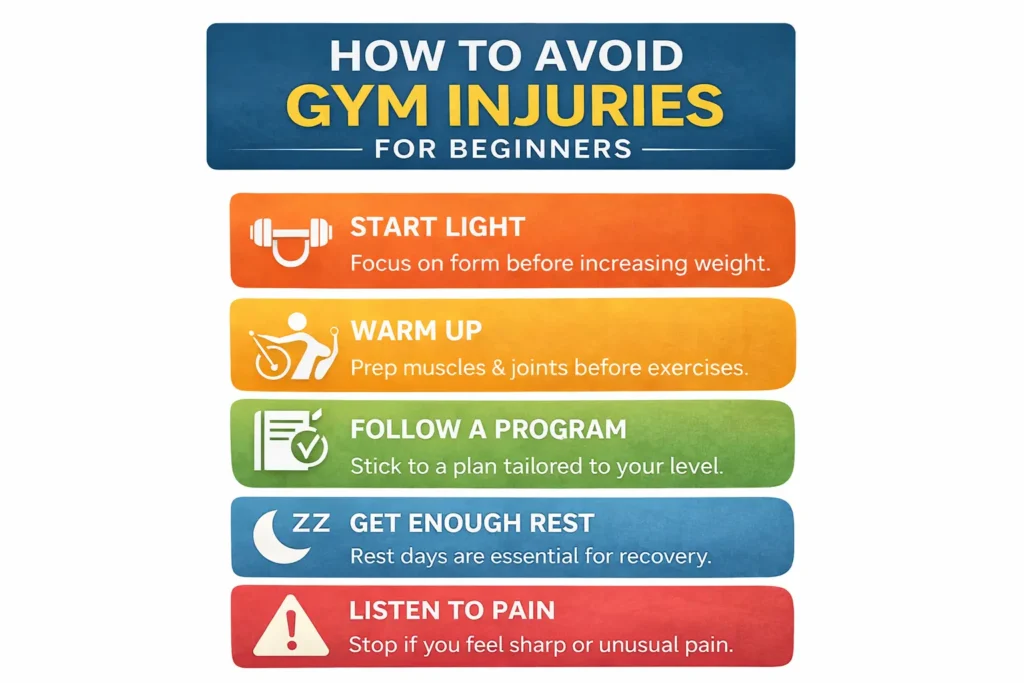
If you want to train safely, keep these in mind:
- Do not rush
Progress comes from good training repeated over time. - Do not train through poor form
Repeating bad movement patterns under load is one of the easiest ways to create problems. - Do not copy someone else’s programme
A plan that works for someone else may be a poor fit for your body and your current level. - Do not let ego choose the weight
Use a weight you can control properly, not one that makes the exercise fall apart. - Do not ignore warning signs
Some soreness is normal. Sharp pain and unstable movement are not. - Build gradually
The best results usually come from consistency, not from doing too much too soon.
Final Thoughts
If you are a beginner, avoiding injury is not about being fragile.
It is about being smart.
The right training should meet you where you are, not where someone else thinks you should be.
Learn proper form.
Respect your starting point.
Use exercises that fit your body.
Build gradually.
And focus on doing something you can maintain. 🙌
That is what keeps you safe.
That is what builds confidence.
And that is what turns training into something that improves your life rather than something you fear.
You do not need to be perfect to begin.
You just need the right starting point and the right guidance. And if you are unsure where to begin, the NHS physical activity guidelines for adults are a useful extra reference.