Beginner Gym Workout: A Simple Plan for Your First 4 Weeks
Starting the gym can feel exciting, but it can also feel overwhelming.
A lot of people walk in with good intentions, then immediately wonder if they are doing the right exercises, using the right machines, or training hard enough to see progress. That is exactly why having a clear beginner gym workout matters.
The goal at the start is not to smash yourself, copy advanced lifters, or leave every session exhausted. The goal is to build confidence, learn the basics, and give your body a plan it can actually recover from.
A good starting programme should help you do three things well:
build consistency
learn proper movement patterns
improve strength and fitness without making training feel complicated
If you are new to the gym, the best approach is usually the simplest one. A few sessions each week, a handful of useful exercises, and enough structure to help you feel like you know what you are doing.
Why Most Beginners Struggle
Most beginners do not fail because they are lazy.
They struggle because they start with too much, too soon.
They either follow random workouts online, jump from machine to machine without a plan, or try to train like someone who has already been in the gym for years. That usually leads to confusion, inconsistency, and poor recovery.
Your training should feel manageable from week one.
You should finish most sessions feeling like you could have done a little more, not like you have been run into the ground. That is what helps you come back again two or three days later and keep building momentum.
This is also where a lot of injury risk comes in. If you are unsure how to move, how to control the weight, or how to progress properly, it is very easy to do too much before your body is ready. If that is something you are worried about, our guide on How To Avoid Injury at the Gym as a Beginner is a useful next read.
What Your Training Should Focus On
At the start, your training does not need to be fancy.
A strong gym plan for a new member should focus on the basics:
squatting or sitting down under control
pushing
pulling
hinging
core control
simple conditioning
That gives you a balanced base without turning your training into a long list of random exercises.
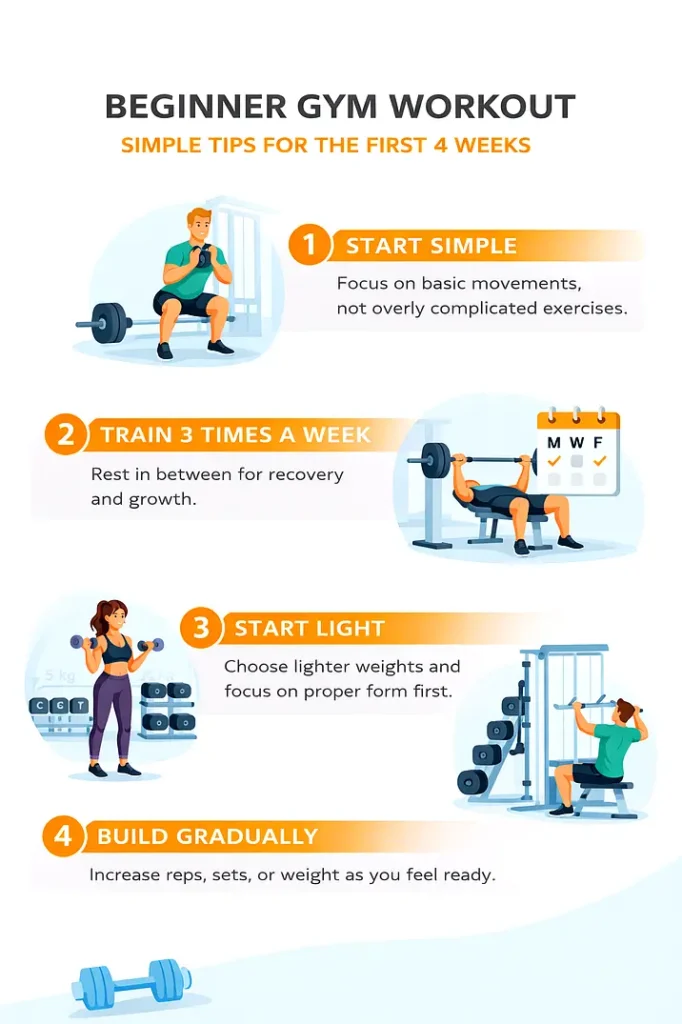
For most people, three full-body sessions per week is a great place to start. That gives you enough practice to improve, while still leaving room for recovery.
A simple weekly structure could look like this:
Monday
Full-body workout
Wednesday
Full-body workout
Friday
Full-body workout
On your days in between, you can keep things light with a walk, some mobility work, or just normal daily movement.
Beginner Gym Workout: A Simple 4 Week Plan
Workout A
Goblet squat, 3 sets of 8 to 10
Seated row, 3 sets of 10
Dumbbell bench press, 3 sets of 8 to 10
Romanian deadlift with dumbbells, 3 sets of 8
Dead bug, 3 sets of 8 each side
5 to 10 minutes easy bike or treadmill
Workout B
Leg press, 3 sets of 10
Lat pulldown, 3 sets of 10
Incline dumbbell press, 3 sets of 8 to 10
Bodyweight box squat or split squat, 3 sets of 8 each side
Plank, 3 rounds of 20 to 30 seconds
5 to 10 minutes easy bike or rowing machine
Alternate Workout A and Workout B across the week. So one week might be A, B, A, and the next week might be B, A, B.
This keeps things simple while giving you enough repetition to improve technique and confidence.
How Hard Should You Train?
One of the biggest mistakes beginners make is thinking every session needs to feel brutal.
It does not.
In the early stages, good training is about learning effort, not chasing exhaustion.
A good rule is to finish each set feeling like you could still do 2 to 3 more reps with solid form. That gives you enough challenge to improve without turning every session into a battle.
Your first month should be about:
learning the exercises
getting comfortable in the gym
improving control
building the habit of showing up
That is real progress, even if it does not look flashy.
How to Progress Without Overthinking It
Progression for beginners does not need to be complicated.
If your form is solid and the weight feels manageable, you can make one small improvement the next time you do that exercise.
That might mean:
adding 1 to 2 reps
slightly increasing the weight
improving control and range of motion
taking shorter rests while keeping form strong
The biggest win is not finding the perfect progression model. The biggest win is staying consistent long enough for simple progression to work.
That is why we always come back to routine and momentum. If that is an area you struggle with, our article on How to Be Consistent With Training will help you build a plan you can actually stick to.
Common Beginner Mistakes to Avoid
This style of plan works best when you remove the things that usually trip people up.
Here are some of the most common mistakes:
Doing too much too soon
More is not better if your body cannot recover from it.
Changing your workout every week
You do not need constant variety at the start. You need practice.
Ignoring form
A movement done well with less weight is better than a messy movement done heavy.
Training with ego
Your starting weights do not matter. Learning proper movement does.
Skipping rest days
Recovery is part of the process, not something separate from it.
Comparing yourself to everyone else
Most people in the gym are more focused on their own session than what you are doing.
What Results Should You Expect in the First Month?
In the first four weeks, your results may not be dramatic in the mirror, but that does not mean the plan is not working.
Most beginners notice things like:
more confidence using equipment
better energy
less soreness after sessions
improved technique
better general fitness
more motivation because training feels less confusing
That matters.
When people enjoy the process and feel themselves getting more capable, they are much more likely to keep going. That is where long-term body composition changes, strength progress, and better health usually come from.
If you want a useful outside reference on training safely as a beginner, Better Health Channel’s guide to resistance training and injury prevention is well worth a read.
Final Thoughts
The best beginner gym workout is not the one that looks the most advanced.
It is the one that helps you show up, move well, and build confidence week after week.
Keep it simple.
Focus on the basics.
Repeat the important things.
Progress gradually.
You do not need a perfect plan to get started.
You just need a plan that makes sense, feels manageable, and gives you a reason to come back for the next session.
That is how beginners stop feeling lost in the gym.
And that is how training starts to become part of your life instead of something you keep putting off.
If you are looking for a beginner-friendly place to get started, Strength & Motion Academy is built to make training feel less overwhelming. With the right support, a clear plan, and a gym environment that helps you build confidence, getting started becomes much easier. You can learn more about the gym here.